Giosetta Fioroni

Giosetta Fioroni (Rome, 1932) was born into a family of artists: her father was a sculptor and her mother a puppeteer. Fundamental to her work were the experiences she developed within the Roman artistic climate of the 1950s, at the Academy of Fine Arts—where she attended the courses taught by Toti Scialoja—and through her close contact with Alberto Burri, Afro, Willem de Kooning, and Cy Twombly.
According to Fioroni herself, the family environment also played a significant role in shaping her career as an eclectic and experimental artist.
At a very young age, she took part in the 1955 Rome Quadriennale and, the following year, in the 28th Venice Biennale. Her true debut, however, came in 1957 with her first solo exhibition at the Galleria Montenapoleone in Milan, introduced by Emilio Vedova.
 
Between 1957 and 1963 she spent long periods in Paris, in a context animated by the Nouveaux Réalistes and by exhibitions organized by Ileana Sonnabend’s gallery, which introduced American, European, and Italian artists, including Jim Dine, Mario Schifano, and Michelangelo Pistoletto. Fioroni worked in Tristan Tzara’s studio, exhibited at the Salon des Réalités Nouvelles, and showed her work in Germany at the Leverkusen Museum, while maintaining close ties with Rome, where in 1961 she exhibited with Umberto Bignardi at the Galleria La Tartaruga.
Defined by Alberto Boatto as the first lady of Italian Pop Art, in the early 1960s Giosetta Fioroni was the only female representative of the movement known as the “Scuola di Piazza del Popolo.” Together with Franco Angeli, Mario Schifano, Tano Festa, Mimmo Rotella, Cy Twombly, Jannis Kounellis, and other artists, she took part in the events organized by Plinio De Martiis at the Galleria La Tartaruga, where she held a solo exhibition in 1965. In 1968, again in the Roman gallery’s spaces, she inaugurated the celebrated festival Il Teatro delle Mostre with the performance La Spia Ottica.
 
In 1964 Giosetta Fioroni exhibited at the 32nd Venice Biennale, the edition that marked the international success of Pop Art. Unlike American artists, however, her painting is distinguished by a constant introspective dimension and by a deliberately artisanal manual approach, practiced through the use of the brush and far removed from the mechanical seriality of Andy Warhol’s silkscreened canvases. Her works capture the instant of a gaze or an emotion, drawing both from everyday life—often filtered through magazines and news imagery—and from learned citations of Renaissance masters.
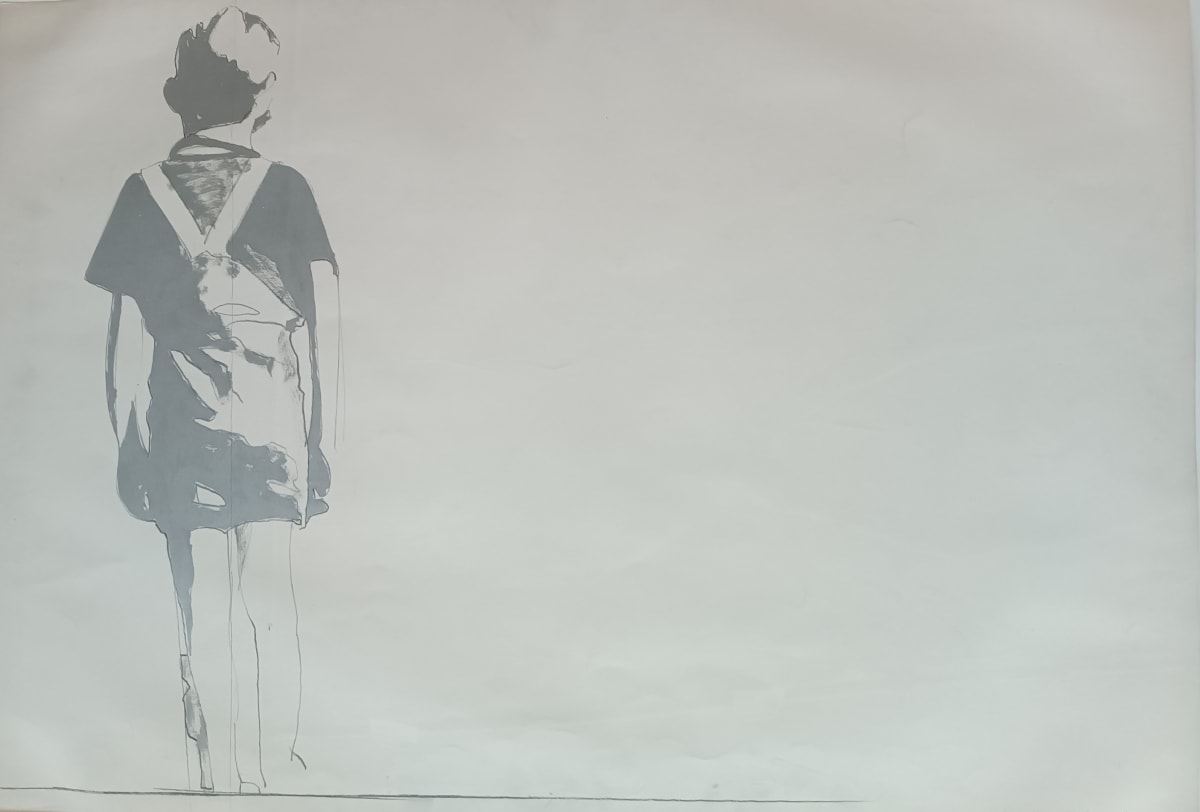
The celebrated Argenti date from these years: images projected onto canvas and painted with industrial enamel paints in aluminum tones, producing a reflective, mirror-like effect that unmistakably characterizes her production of the 1960s. At the same time, Fioroni developed a personal sign-based language, made up of what she herself called stenograms: a kind of allusive shorthand composed of recurring signs—hearts, hands, objects—always charged with symbolic and metaphorical meaning.
On a personal level, from 1964 she was involved with the writer Goffredo Parise, her life companion. Beginning as early as 1963, her work also found a natural evolution in dialogue with poets and writers: from Gruppo ’63—particularly Alberto Arbasino and Nanni Balestrini—to later relationships with Alberto Moravia, Cesare Garboli, Mario Quesada, Guido Ceronetti, Andrea Zanzotto, Erri De Luca, Elisabetta Rasy, Franco Marcoaldi, and Nadia Fusini. The relationship between image and word thus became one of the central axes of her poetics.
The late 1960s saw the creation of the works known as teatrini (little theaters), initially conceived from a wooden model used by her mother for puppet shows. In the same years, Fioroni also began her first experiments with film—16 mm and Super 8 films now preserved at the GAM Video Library in Turin—and with photography, which she later developed in the series Foto da un Atlante di Medicina Legale and Fototeca. In 1970 she took part in the exhibition Vitalità del Negativo, curated by Achille Bonito Oliva at the Palazzo delle Esposizioni in Rome.
 
During the 1970s she spent long periods in the Venetian countryside together with Parise. In this context the cycle of the Spiriti Silvani (Sylvan Spirits) was born, inspired by rural legends and explored through the reading of Vladimir Propp’s studies (Morphology of the Folktale and The Fairy Tale of Magic). From this research emerged the teche: wooden boxes containing leaves, feathers, and small relics collected in the countryside, accompanied by brief annotations about elves, goblins, and imaginary inhabitants of the woods.
At the end of the decade Fioroni returned to painting, first with watercolors, enamels, and oils on canvas, and later with pastel, giving rise to a cycle inspired by the frescoes of Giandomenico Tiepolo in Villa Valmarana in Vicenza (1984–1987).
 
Over time, numerous solo and retrospective exhibitions have been dedicated to her work by museums and institutions, as well as many public collections that hold her works, including the Centre Pompidou in Paris; the Galleria Nazionale d’Arte Moderna e Contemporanea and the MACRO in Rome; the GAM in Turin; the MAMbo in Bologna; and the CSAC of the University of Parma. Among the major solo exhibitions are the retrospective at the Calcografia Nazionale in Rome in 1990, entirely devoted to works on paper, and the invitation in 1993 by Achille Bonito Oliva to present a personal room at the 45th Venice Biennale.
In the same year Fioroni began working with ceramics at the Bottega Gatti in Faenza, shaping in this new medium the recurring themes of her poetics: little theaters, houses, fairy tales of magic, and the garments of literary heroines. In 1999 she created a large statue of a multiethnic Madonna with three faces—European, African, and Asian—for the church of Regina Mundi in Torrespaccata, Rome. Ceramics are also connected to cycles dedicated to nature, such as I 100 alberi (1998, for what is now the MACRO), I 100 fiori, and the Animalia series (2006). At the end of 1999 the Pinacoteca of the Loggetta Lombardesca in Ravenna hosted a broad retrospective of paintings from the 1960s up to that moment. In 2000 the exhibition Giosetta Fioroni, lettere a Amici, Artisti, Poeti…, at the Corraini Gallery in Mantua, highlighted her passion for calligraphy and her relationship with writing, cultivated through books and special editions, sometimes handmade. This was followed by the solo exhibition Dì al tempo di tornare at the Chamber of Deputies (2001) and Senex. Ritratto d’artista (2002), created in collaboration with photographer Marco Delogu and installed in the Ala Mazzoniana of Rome’s Termini Station. In 2003 the Municipality of Rome dedicated a large retrospective to her at the Markets of Trajan, La Beltà. Opere 1963–2003. Her ceramic production, collected in a volume published by Skira in 2005, was presented two years later in a solo exhibition at the MIC in Faenza.
In 2009 the first major monograph dedicated to the artist was published, edited by Germano Celant for Skira, intertwining her biographical path, works, documents, and theoretical-poetic texts.
 
In 2013, on the occasion of the artist’s eightieth birthday, two important retrospective exhibitions opened: L’argento nell’aprile at the Drawing Center in New York and My story at the Galleria Nazionale d’Arte Moderna e Contemporanea in Rome. Between 2013 and 2020 her works were included in numerous group exhibitions at some of Italy’s major museum venues, including the Palazzo delle Esposizioni, the Madre in Naples, the MACRO, the Prada Foundation, the Museo Novecento in Milan, the Quirinale Palace, and the GAM in Turin.
In the same years, abroad, her works were presented in the solo exhibition Giosetta Fioroni. The 60’s in Rome at the MOMMA in Moscow (2017) and in important group exhibitions at the Italian Cultural Institute in London (2018) and the MAMAC in Nice (2020). In 2022 the CAMEC in La Spezia hosted the solo exhibition Il piccolo grande cuore di Giosetta.
On May 24, 2023, Giosetta Fioroni received the Elio Pagliarani National Lifetime Achievement Award.