curated by Alessia Calarota and Giulia Lotti
In collaboration with Fondazione Goffredo Parise e Giosetta Fioroni
The exhibition is part of the Art City Bologna programme
Galleria d’Arte Maggiore g.a.m. presents in Bologna a major and significant exhibition that aims to offer an overview of a highly relevant contemporary artist—an artist written about by Hans Ulrich Obrist and Germano Celant, a source of inspiration for leading contemporary artists, and recently featured in major exhibitions, including one at Fondazione Prada: Giosetta Fioroni.
Galleria d’Arte Maggiore g.a.m. presents an exhibition devoted to the research of Giosetta Fioroni, a central figure in post-war Italian art and a widely acknowledged protagonist on the international scene. The exhibition title, The Future Has Come Out of the Past, echoes a celebrated statement taken from an interview with the artist by Hans-Ulrich Obrist and immediately clarifies the horizon within which her work is situated: a constant dialogue with art history, literature and, more broadly, with memory—understood as an active space for reworking lived experience and the imagination. Not least, Fioroni’s practice stands out for its capacity to exert a deep and lasting influence, still clearly evident today, on the practices and poetics of numerous contemporary artists.
An independent artist, distant from fashions and rigid affiliations, Fioroni has developed over time a lucid and radical visual language, moving freely—both formally and conceptually—across painting, drawing, performance, video, theatre, ceramics and fashion. The exhibition retraces this trajectory beginning with the period immediately following her stay in Paris, when, as a guest in Tristan Tzara’s studio, she came into contact with the vibrant international milieu centred around the French capital in the early 1960s.
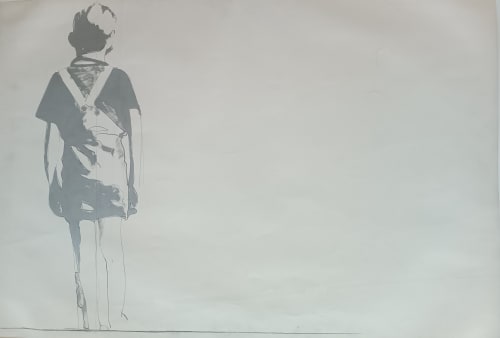
It is precisely at the beginning of this decade that the body of works marking a decisive turning point in her research emerges: the Argenti series, the true focal point of the exhibition. Metallic, reflective yet opaque surfaces, created on paper and canvas, transform the image into an unstable apparition, suspended between presence and dissolution. “Silver is memory, recovery and the suspension of different times,” the artist states. These works, now considered emblematic, define an immediately recognisable visual lexicon. A notable example is A Woman in Silence (1964), an iconic work in which Fioroni explores the female condition with both delicacy and critical insight. Alongside the Argenti, a canvas from the same years dedicated to Carpaccio bears witness to the direct and non-hierarchical relationship the artist maintains with the pictorial tradition, reinterpreted through a deeply contemporary sensibility.
The exhibition path then introduces a reference to La Spia Ottica, the innovative and legendary performance first presented at Galleria La Tartaruga in Rome and re-enacted in recent years at Fondazione Prada at the behest of Francesco Vezzoli and Cristiana Perrella. Developed during the period in which Fioroni was a member of the Scuola di Piazza del Popolo—the only female figure—this work represents a crucial moment in her reflection on the gaze, the apparatus of vision, and the relationship between subject and image, anticipating issues that would later become central to artistic research.
From the 1970s, a phase of intense material and conceptual experimentation, dates the creation of a silvered landscape—an artwork that condenses many of the tensions of that period: the relationship between image and surface, memory and perception, individual experience and symbolic dimension. The exhibition continues through the 1980s and 1990s, marked by an intense material investigation that helps define the artist’s key themes. This is a moment in which Fioroni’s work expands further, maintaining strong internal coherence while traversing different languages and materials.
The work Pisan Cantos, fundamental for its scale and intensity of pictorial research, operates on a plane of stratified cultural references, intertwining the memory of Ezra Pound’s poetry with a visual dialogue with the painting of Francisco Goya, particularly The Parasol.
Finally, the exhibition examines the 2000s, a phase in which the artist consolidates her research around themes of memory, identity and the stratification of lived experience, through the use of signs and symbols that have become distinctive of her language—capable of evoking and reactivating previously traced and fully assimilated paths. A particular focus is devoted to ceramics, with the celebrated Teatrini: small poetic architectures in which personal memories, fairy-tale imagery and literary suggestions intertwine. Alongside these, the Vestitini—evocations of an absent body—take shape as symbolic containers of memory and identity, linked to the female universe that has always been at the centre of the artist’s reflections, bringing the exhibition to a close in an intimate yet universal dimension. In this mature phase, Fioroni’s work asserts itself as a site of poetic resistance and critical continuity, capable of holding together history, lived experience and imagination in a synthesis that remains extraordinarily relevant today.
