
THE STORY.
Galleria d'arte Maggiore, via Massimo D'Azeglio 1 5, Bologna.
Info: 051235843,
www.maggioregam.com.
How did Galleria d’Arte Maggiore come to be?
“My wife Roberta and I founded the gallery at the end of the 1970s, after gaining experience in the art field at a time when there was renewed interest in the cultural sector thanks to the new institutions born in that decade. But very soon we realised that Italy lacked a proper mediator between the most cultural proposals and the enthusiast who, in those years, was beginning to approach the art world and would later become a collector. From the outset our gallery was characterised as a meeting and mediation place between collector, critic, and artist. We can proudly say that some of our clients today are the children of those early collectors—many of whom became close friends—who grew up with us.”
Which artists do you deal with most?
“All 20th-century artists, both national and international. Among the most in-demand names are Balla, Severini, Magritte, Fontana, Léger, and Braque. But over the years we have become a reference point for some masters of the 20th century such as Morandi and De Chirico, although of course we also work with others, through international-level exhibitions and projects.”
And the projects devoted to contemporary artists?
“They are certainly not lacking, but I want to mention three in particular. One is Roberto Sebastian Matta, with whom we had a direct relationship that began fifteen years before his death, following and supporting him both in the Italian and international markets, with major exhibitions and with collectors. A choice that proved successful, as the interest in his work continues to grow abroad. Then Robert Indiana, who represents our Pop soul: with his monumental sculptures we organised a public exhibition in the streets of Cortina d’Ampezzo a couple of years ago. I cannot reveal much yet, but you will hear about him again in Europe soon. And finally Sandro Chia, who fits perfectly within the renewed international interest in figuration and the current return of the Transavanguardia in Italian museums—such as the exhibition at Palazzo Reale in Milan, preceded by a monographic show at the International Museum of Ceramics in Faenza. Many of the works displayed on that occasion can now be viewed in our gallery spaces. We will dedicate our stand at the Hong Kong fair in May entirely to Sandro Chia.”
How do you view Bologna and Italy from an artistic and cultural standpoint?
“It is a sensitive subject: the economic crisis is testing our country, but culturally I see a renewed energy. Italian artists, strictly from the artistic standpoint, have nothing to envy from foreign ones—if anything, it is our institutional and private system that does not invest enough in young talents, either financially or culturally. Museums run by young directors, such as MAMbo, lack the means of major foreign institutions but still present interesting exhibitions. A museum like Palazzo Fortuny in Venice, thanks to Daniela Ferretti’s direction, has succeeded in asserting itself internationally with innovative, high-quality exhibitions without major funding. The success of a fair like Artissima in Turin shows that in Italy it is still possible to sustain a market if galleries are given the space and importance they deserve. We should start from these examples to build the future.”What has changed in collecting and in gallery activity?
“I can’t generalise—every case is different—but for us, our activity has changed greatly over the years and continues to evolve. The secret is to anticipate what is to come, and for this I am pleased that my daughter Alessia took over the gallery’s direction in September 2011. Working together allows us to combine my and Roberta’s consolidated experience with a vision more aligned with our time. Our greatest strength is precisely the family, which guarantees the right balance between tradition and innovation, as well as continuity in our choices, always founded on quality, substance, stability, and concreteness.Certainly, the rules have changed: when my wife and I started out, we travelled from city to city; today the market has become global. Take the innovations of the past ten years—such as the internet—which on the one hand places users before a disproportionate amount of information, not always accurate, about art and the market, but on the other makes it possible to be visible and make one’s work known even to those very far away geographically or culturally. And precisely to manage all this information, to guide taste, I firmly believe it is even more important than before to have an expert by one’s side—a mediator like the gallerist—who can advise the collector, as happens abroad.”
So you do not think, like many of your colleagues, that the profession of gallerist is in crisis?
“On the contrary, I maintain that never before has there been such a need for us gallerists. We must remind everyone that a substantial part of the art system is based on us. A fair without high-quality galleries loses importance. An artist who sells directly to the collector loses value on the market. A collector who thinks he can acquire a work below its full price devalues the artist whose work he is investing in. We gallerists are the guarantors of this system—not the auction houses which, although important, cannot circulate artists and works as we do.”
THE WORKS IN THE GALLERY.
MASTERS OF THE 20TH CENTURY
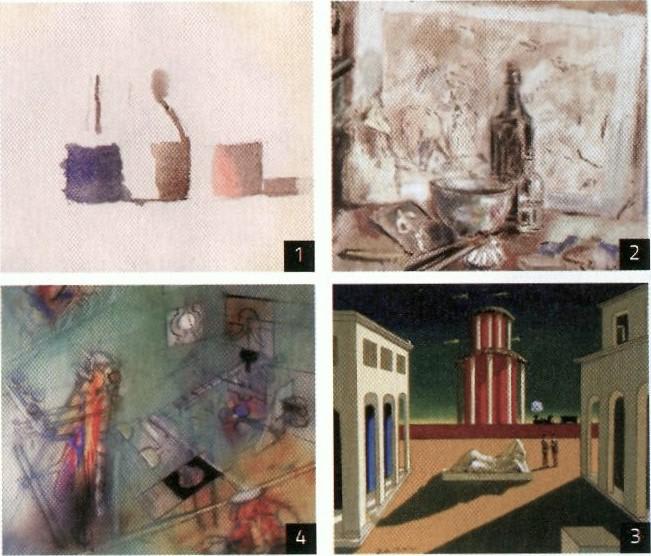
Giorgio Morandi (1) Natura Morta, 1960
Filippo De Pisis (2) Natura Morta con stampe, 1928
Giorgio de Chirico (3) Piazza d'Italia con Arianna, 1964
Sebastian Matta (4) Senza Titolo, 1959
THE CALAROTA FAMILY.
A LIFE AND WORK ADVENTURE
Franco (Bazzano, Bologna, 4 November 1945) and Roberta Calarota met during high school, where their passion for art was born and where a life journey began that would also lead them to work together. Their daughter Alessia inherited from her parents a love for this profession: with a degree in literature and a specialisation in art history, she is now the director of Galleria d’Arte Maggiore, which she manages with her parents in a perfect union of tradition and innovation, also opening a new path toward contemporary artists.
the exhibition
"GOING BEYOND".
The current exhibition at Galleria d'Arte Maggiore pays homage to one of the most important artists of the Italian Transavanguardia and one of the most celebrated and valued internationally: Sandro Chia. The show, titled Going Beyond, retraces Chia’s artistic career through a carefully curated selection of historical and recent works that illustrate his entire creative path. Moreover, for the first time in the prestigious Bologna venue, the refined ceramic works created for the exhibition Sandro Chia, ceramica vs disegno 1:0 will also be on view. On display until 15 April.
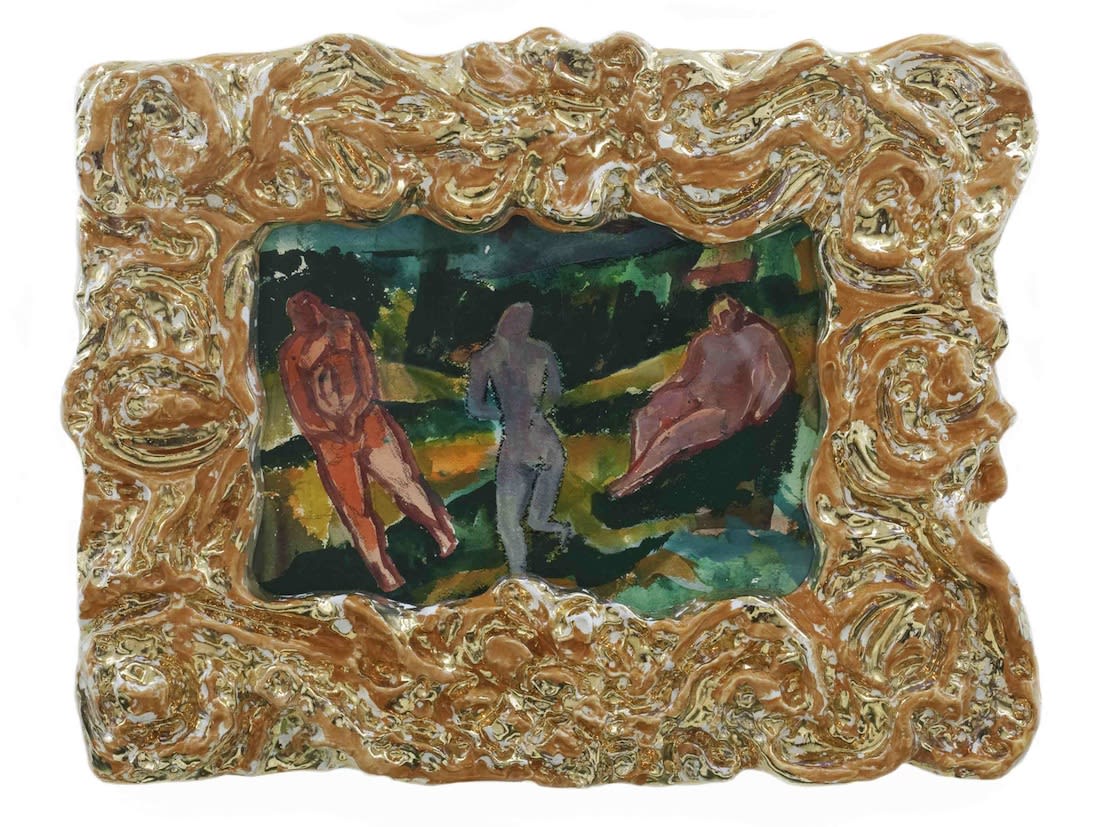
Sandro Chia, Cornice, 2011


