Twenty-eight scale models of the F40 stacked one on top of the other form, in the mass reconstructed by the pop artist Arman, the outline of the Prancing Horse. It is the great monument to Ferrari, which will welcome spectators in Imola in front of the racetrack. A monument to a myth, five meters high on a base measuring one meter eighty. And today, on the occasion of the Grand Prix practice sessions, the monument will be officially inaugurated.
The idea was born more than two years ago, right in Imola, from discussions between the artist and Franco Calarota, owner of the Galleria d’Arte Maggiore in Bologna.
Ferrari is famous all over the world; its legend has endured even the modest sporting results of recent years. And yet no one, in an age when a small bust is denied to no one, had thought of giving it a representation meant to last over time. This is the idea from which Arman’s work takes shape. The first sketches were submitted to the municipality of Imola, which approved them. With the help of a foundry in Pietrasanta, which began producing reproductions of the famous model, Arman started working on his creation.
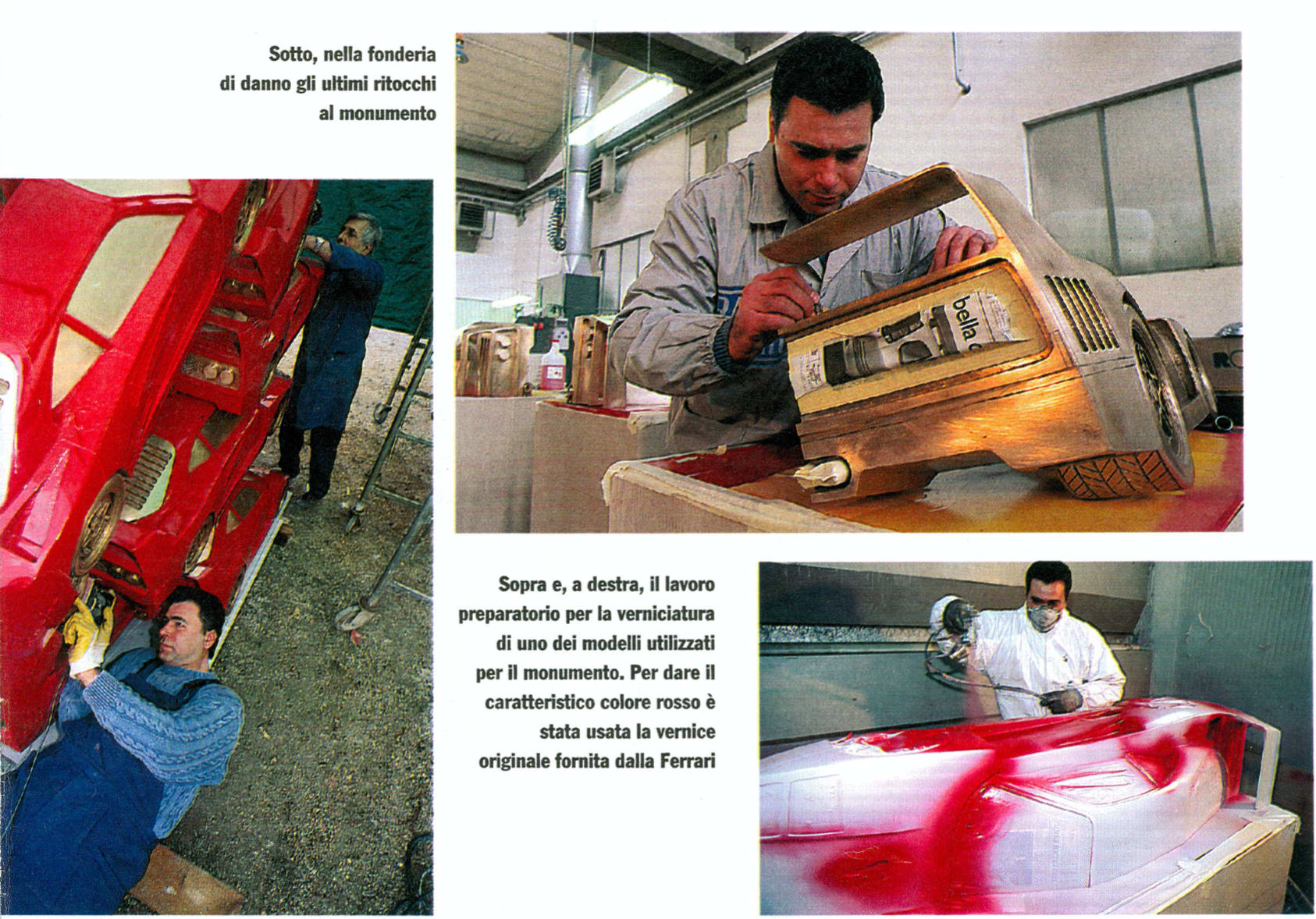
Each model, about one meter sixty long, was sectioned, and from these sections the monument gradually took shape in its final version. The painting was then carried out at a facility in Bologna.
Ferrari itself supplied the cans of paint used to give the monument its characteristic red color in its final version. Sagis, the company that manages the Imola racetrack, then oversaw the placement of the work as part of a broader project aimed at redeveloping the square in front of the entrance to the sports facility.
The initiative is part of the celebrations for the centenary of Enzo Ferrari, which fell last year, and also commemorates the first victory of a “red” car in a Formula 1 Grand Prix.
Born in Nice in 1928, Arman is famous for his “accumulations,” works made up of the accumulation of various objects from the real world. Among his monuments are Pablo Casals’ Obelisk in Connecticut; L’Heure de tous and the Monument à la République in Paris; Ascend of the Blues in Memphis; Rostropovich’s Tower in New York; and Persépolis in Dallas. From 1995 dates Hope for Peace in Beirut, a large concrete installation over 32 meters high that “accumulates” a series of tanks.
Last year, a major retrospective of his work was hosted at the Jeu de Paume in Paris.