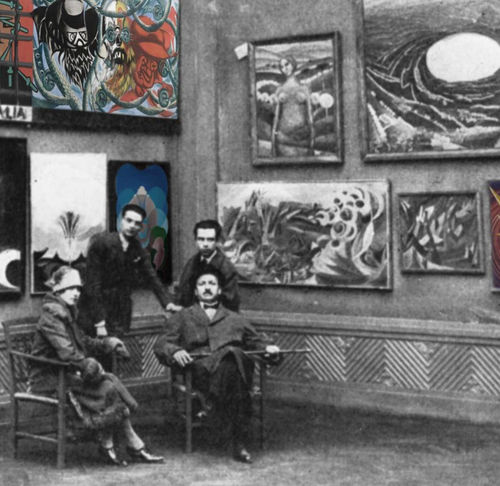
Giacomo Balla (Turin, 1871 – Rome, 1958) is regarded as one of the most important figures in twentieth-century Italian art and one of the leading protagonists of Futurism. A versatile artist and tireless experimenter, he was among the few members of the Italian avant-garde to extend his research to every field of artistic creation, never limiting himself solely to painting. Throughout his career, he also worked in design, interior decoration, architecture, stage design, and fashion, anticipating the modern idea of art as something capable of permeating every aspect of everyday life.
After his early experiences associated with Divisionism, Balla developed an increasingly innovative visual language that found its fullest expression in his adherence to the Futurist movement. At the core of his research was the analysis of movement, speed, and visual perception, explored through the dynamic fragmentation of reality and the representation of the flow of light, color, and form through space and time. His work is rooted in a profoundly modern vision, supported by a scientific and positivist approach that regarded art as a privileged tool for interpreting and transforming the contemporary world.
His interest in a total conception of art also led him to explore the relationship between artistic creation and everyday life. Influenced by the experiments of the Russian avant-garde artist Mikhail Larionov and by the experience of Sergei Diaghilev’s Ballets Russes, in 1915 he designed Futurist garments characterized by mobile plastic elements and a strong dynamic component, helping to redefine the very concept of fashion as a form of artistic expression.
His international reputation was consolidated through participation in some of the most important artistic events of his time. Among the most significant historical exhibitions were the Salon d’Automne in Paris in 1909 and the exhibition at Der Sturm Gallery in Berlin in 1913, both crucial to the dissemination of the European avant-gardes. Recognition of his role in the history of twentieth-century art has also been confirmed by the international art market: in 2013, the painting Automobile in corsa (1913) was sold by Sotheby’s in New York for $11,477,000, achieving one of the highest auction results ever recorded for a Futurist work.
Today, Giacomo Balla’s works are held in the collections of some of the most prestigious museums in Italy and abroad. In Italy, his works are represented, among others, at the Galleria Civica d’Arte Moderna e Contemporanea in Turin, MART of Rovereto, and the Peggy Guggenheim Collection. Internationally, his works are included in the collections of the Art Institute of Chicago, the San Francisco Museum of Modern Art, the Museum of Modern Art (MoMA) in New York, and the Museum of Fine Arts, Boston, testifying to the global significance of his artistic production.
Numerous museums have also dedicated important retrospective exhibitions to Balla, further examining his contribution to modern art and the historical avant-gardes. Among these are the exhibitions organized by the Museum of Modern Art (MoMA) in 1949, Tate Britain in London in 1980, and the Philadelphia Museum of Art in the same year.
More recently, the critical reassessment of Giacomo Balla’s oeuvre has been confirmed by major international exhibitions devoted to Futurism and twentieth-century Italian art, including Italian Futurism, 1909–1944: Reconstructing the Universe at the Solomon R. Guggenheim Museum in 2014 and Post Zang Tumb Tuuum. Art Life Politics: Italia 1918–1943 at Fondazione Prada in 2018, curated by Germano Celant. On both occasions, Galleria d’Arte Maggiore g.a.m., which handles works by the artist, collaborated with the exhibition projects, contributing to the promotion and further study of his artistic production. These initiatives confirm the central role that Balla continues to occupy in the history of international art.